Local detail
Doing Nothing For Now
If your door won't open and you can hear the spring is broken, it's fine to leave it alone for a day or two while you sort out a repair. A garage door with a snapped torsion spring is just a heavy slab held up by nothing but the opener's motor, and most openers aren't built to lift that weight on their own for long. Don't keep hitting the remote. Every time you do, you're asking a chain or belt drive to do a job it was never meant for, and that's how you turn a spring call into a spring-and-opener call.
For houses in this service area, where a lot of garages date back to the 1960s and 70s, waiting a short while isn't usually a problem - these doors were built heavier than a lot of what's sold today, and the hardware tends to hold even when the spring doesn't. What you shouldn't do is leave a car trapped inside through a stretch of sub-zero nights with the door propped open by hand. Cold makes steel brittle, and a spring that's already fatigued is more likely to let go further, or take a cable with it, if it sits under strain in freezing temperatures.
If you've got somewhere else to park for a few days, that's the easier path. If not, get the door manually secured and leave the opener alone until someone looks at it.
The area
What Is Going On
Torsion springs are rated for a number of cycles - open and close counts - and they wind down whether you use the door ten times a day or twice a week. What tips a spring at the end of its life, especially here, is cold. Steel contracts and gets less forgiving when temperatures drop into the kind of severe cold this area sees most winters, and a spring that was already near the end of its cycle count often picks the coldest morning of the year to finally go. That's not bad luck - it's just physics catching a weak point.
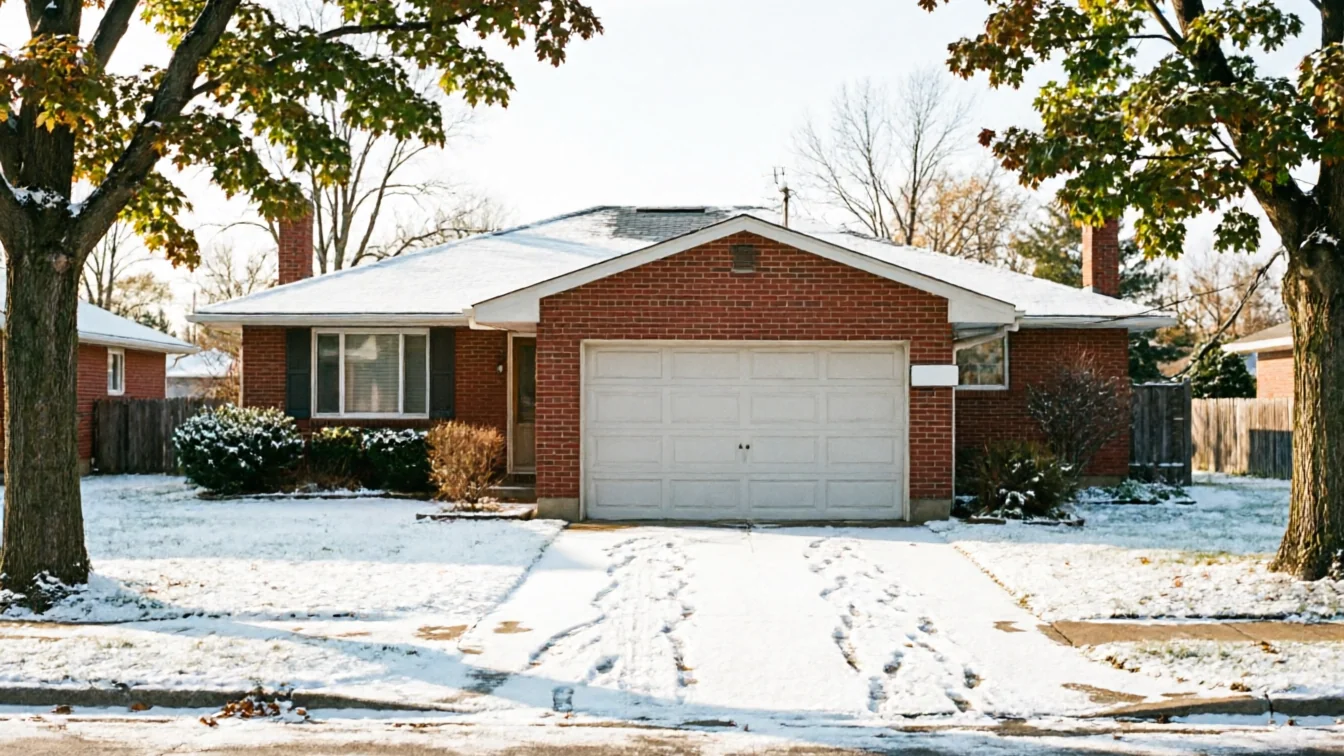
Houses in this area built between 1949 and 2000, with most of the stock going up through the 1960s and 70s, are now carrying springs that have either been replaced once already or never replaced at all. A spring installed when a house was built in 1973 has had a long run. If it's original, it's not a question of if it breaks, it's when, and a cold snap is the most common trigger.
If the door won't budge, shows a visible gap in the spring above the door, or the opener strains and reverses, that's almost always a torsion spring failure - not a track or opener problem, even though it can look like one from the garage floor.
What we find
Checking It Yourself
Before you call anyone, a few things are safe to check on your own. Look up at the spring across the top of the door - if it's torsion, you'll see a gap of an inch or more where it's snapped. That confirms the diagnosis and tells you not to force the opener.
Next, check whether the door has one spring or two. Many older local garages, especially the single-car doors common in houses from the 1960s and 70s, were built with a single torsion spring. If that's what you have, know going in that a single-spring setup on a heavier wood or insulated door puts more strain on that one spring, which can mean more frequent replacement than a comparable two-spring system.
Also worth a look: the cables on either side of the door. If a cable has come off the drum or frayed, don't attempt to free it yourself - that's under real tension and it's where people get hurt. If the cables look intact and it's just the spring, you've done the useful part of the diagnosis. What you shouldn't do is try to unwind or rewind a torsion spring. The tool and the technique matter more than confidence does, and this is the one repair on a garage door where a mistake can seriously hurt you.
How we work
What Local Conditions Do
Cold is the main factor working against springs in this area, but it's not the only one. With winters running into severe cold most years, metal fatigue accelerates faster here than it would somewhere with milder swings, which means a spring rated for a given cycle count may still fail a season or two sooner than the number on the box suggests. That's one reason we don't push a spring to its theoretical limit before swapping it - by the time it's visibly struggling in winter, it's already past the point of trusting it through another cold stretch.
The age of the housing stock plays into this too. A lot of garages across this service area - including homes near Sergeant Bluff, Hinton, Lawton, and the other towns within about 20 miles - were built in the decades when single-spring torsion setups were standard and steel-and-insulation specs were lighter than what's used today. That means older original springs, lighter doors that shift more in high wind, and hardware that wasn't engineered with today's colder-than-average failure patterns in mind.
One honest limitation: we can't speed up how fast a replacement spring ships if yours is a less common size for an older door. Most jobs we handle use stock sizes, but if your door is original to a house from the 1960s or earlier, it's worth asking about the spring size before you assume next-day service.
Talk to a local pro
Garage door trouble in Sioux City?
Same-day service with honest, upfront quotes.